
ITI EX:CHANGE – reflections on a theme
It’s the first week of the month, which means theoretically it's time for a CPD round-up! However, since the bulk of my CPD in July was attending the ITI's EX:CHANGE conference, I’ve decided to focus on that this month instead.
Now, cards on the table: I, along with co-host Nicholas Nicou, was invited to the conference with our Source2Target hats* on, which meant that we did attend the conference for free. It also meant we were mentioned a few times and even got to see the logo up on the big screen!
*Not literal hats, unfortunately. We don’t have merch, but maybe we should…?
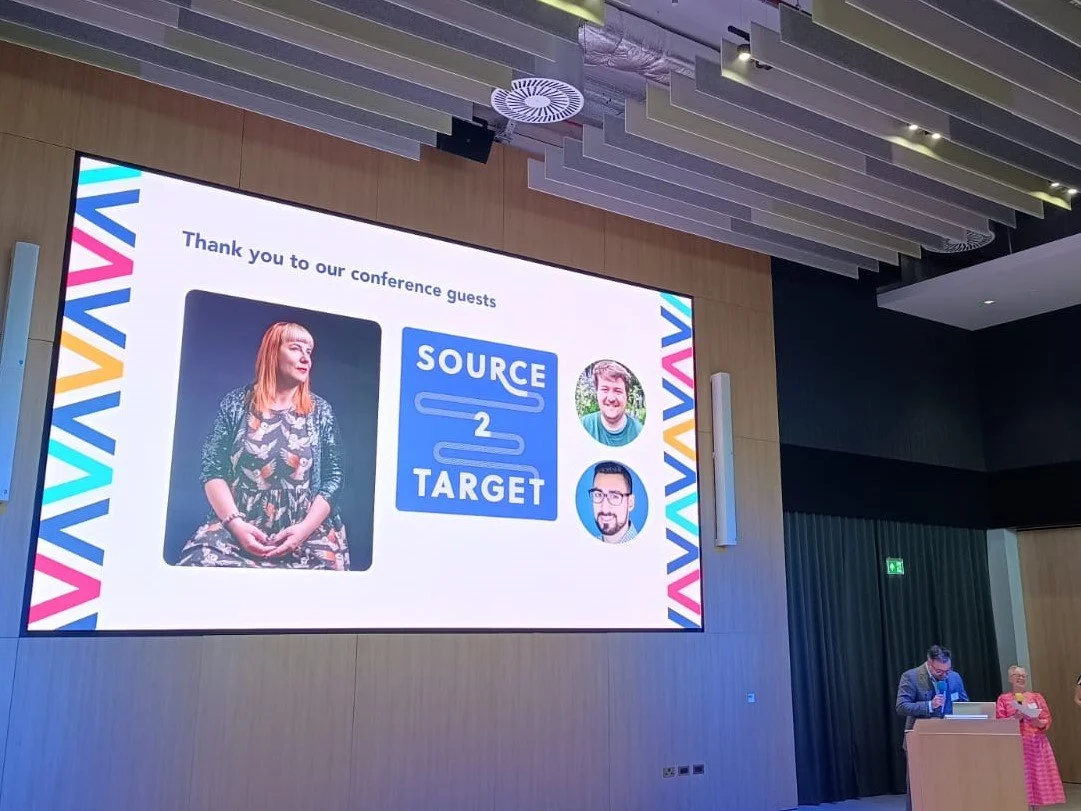
Our little podcast on the big screen!
However, the fact that we attended for free is important because the price point of the conference has been a real point of controversy for many in the ITI community. Conferences are inevitably expensive, especially for newer entrants – even at discounted student rates. As to whether it was justified for us to attend the conference for free, given that our primary target audience is newer entrants with less disposable cash, I can only hope that the detailed reflection episodes we will be putting out at the end of the month for free justify the benefit we received and provide some level of access to the conference, even for those who couldn’t be there in person.
Those episodes will be available on the main feed, and I’ll add them here in due course. If you can’t wait that long, I highly recommend Holly-Anny Whyte’s blog post on the conference, which provides a detailed blow-by-blow breakdown of the main themes and events.
Instead, I thought I would focus here on the session that I was most heavily involved in: ethical practice. Yes indeed, even before we had been invited as a podcast to the conference, I had already agreed to sit on the ethics session and be one of the facilitators for the group discussions afterwards, organised by Lindsay Bywood, Joseph Lambert and Ramon Inglada. This was the format of the main conference sessions – introductions and/or keynote speakers, followed by group discussions, with facilitators going round each table.
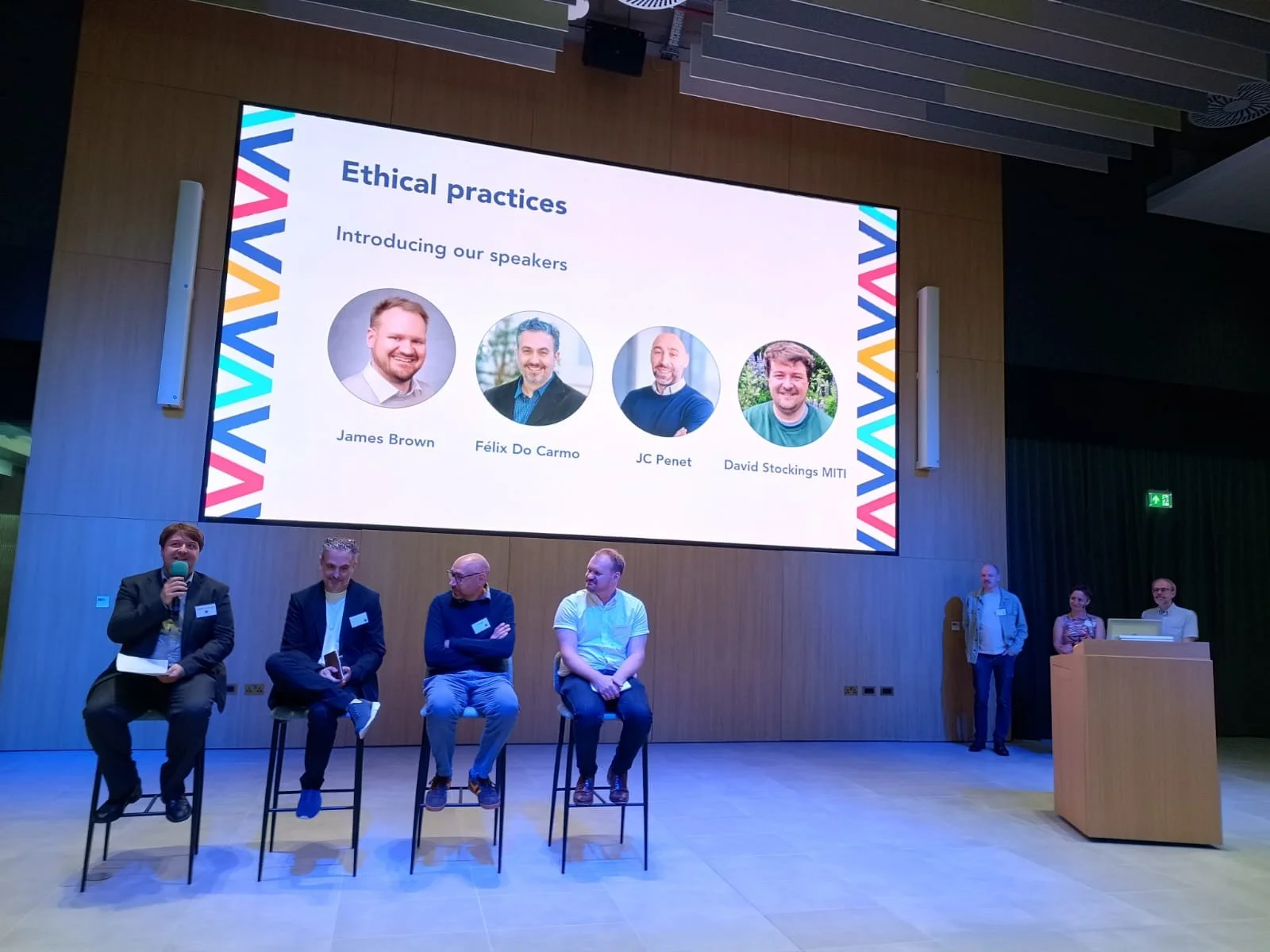
I joked at the time that the stools made us look like the world’s worst acapella singing group, but I do have to acknowledge Holly’s critique that a panel of four white men is not exactly representative of an highly international industry where most of the actual linguists are women.
It won’t surprise you to hear that I love to chat, and especially about translation to other translators. Given that I work as a translation trainer and regularly get up in front of a room full of students to talk to them about translation, it may surprise you to learn that I was a bit nervous about the opening panel.
Or rather, the opening ‘provocation’, as it was called. And I did my best to be provocative. I won’t be self-indulgent by repeating everything I said, but the central thrust of it was “I’m sick of being told that AI is inevitable,” and I drew inspiration from the way the “radical” farmers that I spend a lot of time face down the “inevitable” every day. This seemed to go down well in the room. It was, fortunately, the shortest of the opening sessions, with no keynote speaker and plenty of time for discussions.
The discussions were the really interesting bit, however. As one of the facilitators, I rotated around 4 (or 5?) different tables contributing where I could. Actually, very little contribution was required from me most of the time. Either we had been sufficiently provocative in the opening panel or, as I suspect, attendees already had plenty of ideas of their own to share, and the conversations were, for the most part, in full flow.
One thing that really did strike me though is that each of the tables I visited were having completely different conversations. Even looking back at my notes now, I find it difficult to synthesise them into some sort of neat summary. They covered a huge range of issues like:
What exactly is the translator’s role?
Is the practice of ‘light’ MTPE inherently unethical?
Is quality an ethical issue, or a purely mechanical one?
How do we deal with bias in AI data?
Are translators held to different quality standards that LSPs?
How can we make the opportunity cost of using AI clear?
How can we team up, acknowledge each other and develop new models of working together?
What terminology should we use for AI content?
How do we shine a light into the black box of how translations are actually created?
Is there a lack of linguist involvement in decision-making?
How do we balance our ethical concerns with need to make enough money to survive?
It was enough to send your head spinning, and I think it’s fair to say that most of the attendees will have left that session with more questions than answers. This isn’t meant as a criticism. I would be deeply wary of any individual or group who claimed to have the definitive answer to what it means to practice translation ethically and to be in a position to tell others what to do – not just in relation to AI, but generally.
And I don’t think that outcome was unexpected. What exactly was the point of the session then? The somewhat cliché answer would probably be ‘to get everyone talking to each other’. Okay, fair enough. But why? Why should translators be talking to each other (and to the limited number of language industry representatives) about translation ethics?
Well, for me at least, I found it bolstering to know I wasn’t the only one thinking the way I think. As I said in the provocation, I don’t mind being considered a crank. Again, I draw inspiration from the “radical” farmers that I met in the course of my work – crankhood isn’t something to be ashamed of, or even something to be proud of, it’s not anything really. To be called a crank is to be belittled by deeply unimaginative people who supposedly know better about the “real” world. And those people are to be ignored and proven wrong through demonstration rather than argumentation.
And yet, the other thing I have learned from these farmers and growers is that it’s always better to be part of a tribe, particularly when you are pushing against the mainstream. When you get into a room with people working in this world, there is always this incredible energy, a kind of alchemy of kindred spirits. And the thing that I’ve always admired about the way they operate but found hard to put into words is that they can be separated by vast distances and only meet each other every few years, and yet they still find a way to inspire and be inspired by each other. They are like beacons in the night – communicating support and encouragement simply by their presence, by proving that things can be done in a way that is aligned with a shared set of values, despite what the “sensible” majority think.
So when we get together to talk about these issues, we are putting our positions on the table and inviting others who think the same way to connect with us, so we can be beacons to each other. That may not have been the organisers’ intention exactly, but that’s what I’m deciding to take away from it. I know I’m not the only one who thinks the way I do, and knowing that is a key part of restoring that sense of possibility that I mentioned in the opening provocation and that is expressed so perfectly in the song I quoted:
Coda: An afterthought
The last sentence may have seemed like a logical place to end, but I’ve got one more – not fully formed – idea I want to throw into the mix.
I said that it was hard to pick out a particular theme or issue as the central ‘plank’ of the ethics discussions. And that is true, but there was a certain emotion running through most of the discussions: unfairness.
Fairness is at the heart of ethics, of course, including of translation ethics. But I recently read “What's in a Name? Mapping the Translation Industry”, the opening chapter of Walker & Lambert’s (2025) Routledge Handbook of the Translation Industry, and it prompted me to realise something about the sense of unfairness I had felt in those conversations. Very few people there were concerned about the ethics of translation per se – it was more about the unfairness of certain business practices in the translation industry.
This connected with Walker & Lambert’s work in that they propose distinguishing a new sub-domain of Translation Studies that they call Translation Industry Studies. This is interesting because it would create a new area that would gather together work not so much on how translation is practiced by translators, but rather how the industry within which it is practiced operates.
Could this pave the way for a field of study devoted specifically to Translation Industry Ethics? To some extent, this may have already started. Look at FairLoc for example – as a certification system, their mission is to ensure that fairness is embedded as a core component of translation industry quality, rather than an afterthought. It’s only the glimmer of an idea at the moment, but perhaps Translation Industry Ethics could provide a focal point for concerted, proactive efforts to build a fairer translation industry?
Another question to add to the list.
Edit history:
The paragraphs immediately after the first image (“However, the fact that we attended for free…”) were amended on 10 August to correct my previous incorrect assertion that no discounted student rates were offered.